
When Upfit Equipment Quality Becomes a Safety Issue: Why the Details Matter


When outfitting a commercial work van, most businesses focus on storage capacity, organization, functionality and cost. These are all important considerations, but there's another factor that deserves just as much attention: the quality of the upfit equipment itself.
At first glance, two shelving systems or partitions may look very similar. Both may fit the vehicle, provide the required storage space and serve the same basic purpose.
But look closer and the differences become more apparent.
The quality of the bracing, the strength of the mounting points, the load capacity of the shelves and how precisely a partition fits the vehicle can all influence the durability, reliability and safety of an upfit.
For tradespeople who spend their working days on the road, these details matter.
A commercial van isn't a stationary storage room. Every day, its equipment is exposed to vibration, acceleration, braking, cornering and changing loads.
When upfit equipment isn't built to handle these demands, what initially looks like a minor quality issue can become a serious safety concern.
1. Shelving Quality: It's More Than How Much Weight a Shelf Can Hold
Shelving is often the foundation of a commercial van upfit. It keeps tools, parts and equipment organized and accessible throughout the workday.
But not all shelving systems are built to the same standard.
One of the first specifications buyers should consider is load capacity.
A shelf holding small parts and lightweight tools has very different demands from one carrying heavy equipment. Choosing shelving without considering its rated capacity can lead to overloading, deformation or structural failure.
However, load capacity is only part of the story.
Pay Attention to Bracing and Structural Support
Something as simple as the quality of a shelving brace can make a significant difference.
Commercial vans experience constant movement. Road vibration, sharp turns, sudden stops and repeated loading can put stress on shelves, brackets, fasteners and mounting points.
If a shelving system has inadequate bracing or weak connections, it may experience excessive movement, loosening components or structural fatigue over time.
This is why it's important to evaluate the shelving system as a complete assembly, rather than simply looking at individual shelves.
When comparing van shelving, consider:
Load capacity: How much weight is each shelf rated to support, and under what conditions?
Bracing and reinforcement: Are the supporting components strong enough to provide stability during everyday vehicle operation?
Mounting points: How securely does the shelving attach to the vehicle?
Connection quality: Are the brackets, fasteners and joints appropriate for the demands of commercial use?
Material quality: Will the shelving withstand repeated loading, vibration and everyday wear?
At Packd Upfit Equipment, our aluminum shelving systems are designed for commercial van applications, with shelves rated to support up to 250 lbs each when installed and used according to specifications.
The shelving system is more than a place to put tools. Its structural components, bracing and connections all contribute to how reliably it performs.
A strong shelf alone doesn't make a strong shelving system.


2. Partition Quality: Fitment, Construction and Mounting Matter
A cargo van partition does more than separate the driver from the tools and equipment stored behind them. It can play an important role in occupant protection, air quality, climate control and driver ergonomics.
During sudden braking or a collision, unsecured tools and materials can shift forward with significant force. A properly constructed and installed partition provides an additional physical barrier between the cargo area and passenger compartment, helping protect occupants from shifting loads.
Partitions can also help limit the movement of dust, odours and potentially harmful fumes from the cargo area into the cab. However, the effectiveness of this separation depends on the partition's construction, fitment and sealing. A partition is not a substitute for proper ventilation or safe storage of hazardous materials.
Another benefit is improved climate control. By separating the cab from the larger cargo area, a well-fitted partition can help maintain a more comfortable temperature for the driver, particularly during extreme hot or cold weather.
Ergonomics is another important consideration, and the right partition style depends on how technicians use their vehicles. For technicians who spend long hours driving, a contoured partition can provide additional seat recline and adjustment, supporting a more comfortable driving position. For technicians who frequently need to access equipment from inside the vehicle, a walk-through partition can make moving between the cab and cargo area more convenient.
What Should You Look for in a Quality Partition?
Vehicle-specific fitment: A partition designed for the vehicle's make and model helps minimize gaps and supports secure installation.
Material and construction quality: Steel and composite partitions offer different characteristics, including durability, noise reduction and thermal insulation.
Mounting strength: Secure attachment points and appropriate hardware are essential to how a partition performs.
Separation and sealing: Proper fitment helps limit airflow, dust and odors between the cargo area and cab.
Ergonomic design: Contoured and walk-through options accommodate different driving habits and daily workflows.
Packd offers vehicle-specific steel and composite partitions, including contoured and walk-through options designed to accommodate different working needs.
A quality partition isn't simply one that fits inside the van. It's one that's properly constructed, securely mounted and suited to how the vehicle is used.
When Partition Quality Is Put to the Test
The importance of a well-built partition becomes especially clear when the unexpected happens. In a real-world incident, a driver was forced to make a hard panic stop at highway speed, causing a heavy load to break loose and slam into a Packd partition. While the partition sustained some damage, it prevented the equipment from entering the driver's compartment.
This incident demonstrates why partition construction, mounting strength and overall structural integrity matter. When safety is on the line, the quality of your upfit equipment can make a critical difference.

3. Tank Holders: Why Quality and Securement Are Especially Important
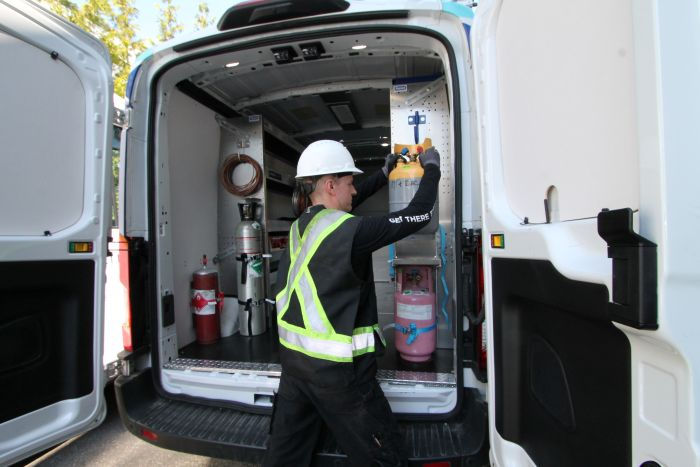
For HVAC technicians, plumbers and other tradespeople, transporting compressed gas cylinders is often part of the daily routine.
These cylinders require special attention because an unsecured or damaged cylinder can present serious hazards.
If a cylinder shifts, tips or falls during transit, it can damage surrounding equipment or potentially compromise the cylinder or its valve.
This makes the quality of the tank holder and its restraint system particularly important.
Proper Cylinder Securement Is a Safety Requirement
In British Columbia, Canada, WorkSafeBC Occupational Health and Safety Regulation 5.38 requires compressed gas cylinders to be secured against falling or rolling during transportation, storage and use. The regulation also requires cylinders to remain upright where practicable.
In the United States, the Department of Transportation's 49 CFR §177.840 requires Class 2 gas cylinders to be appropriately restrained, secured in racks or packaged to prevent shifting, overturning or ejection during normal transportation conditions.
Additional requirements can apply depending on the task. For example, OSHA Regulation 29 CFR §1926.350 specifies vertical cylinder securement when cylinders are transported by powered vehicles in covered construction operations.
Not All Tank Holders Are Created Equal
When evaluating a tank holder, consider the quality of its construction and how effectively it accommodates the cylinder.
Important details include:
Proper sizing: Is the holder designed for the specific cylinder size and type?
Restraint quality: Does it provide a suitable way to secure the cylinder against movement?
Mounting strength: Are the mounting components appropriate for the weight and intended use?
Construction quality: Are the materials, connections and supporting components suitable for repeated commercial use?
Accessibility: Can technicians secure and remove cylinders without unnecessary difficulty?

Packd offers purpose-built tank storage solutions for common HVAC applications, including nitrogen and acetylene cylinders.
Rather than relying on an improvised arrangement, technicians can select equipment designed around the dimensions and storage needs of specific cylinder types.
Of course, a properly constructed holder is only part of safe cylinder transportation. Technicians must also follow applicable handling, orientation, valve protection and transportation requirements.
When equipment contains compressed gas, details such as restraint quality, mounting strength and proper fitment can have important safety implications.
4. Lightweight Equipment: Quality Matters More Than Material Alone
Weight is another factor businesses should consider when selecting upfit equipment.
Heavy shelving and storage systems consume part of a commercial vehicle's available payload capacity, reducing the weight available for tools, supplies and other equipment.
For service vans carrying substantial loads, this can become a significant consideration.
Lightweight materials such as aluminum and composites offer advantages, but material selection alone doesn't determine equipment quality.
Two aluminum shelving systems may use similar materials yet differ considerably in reinforcement, connection quality, load capacity and structural stability.
A well-built lightweight system should combine reduced weight with the strength and support appropriate for its intended use.
Packd's aluminum shelving systems are approximately 60% lighter than comparable steel shelving, helping businesses preserve valuable payload capacity.
However, lighter equipment does not automatically increase a vehicle's allowable payload rating, and fleet operators must still ensure the fully loaded vehicle remains within its weight limits.
The goal isn't simply to choose the lightest equipment. It's to choose equipment that delivers the right balance of weight, strength, durability and load capacity.
5. Quality Equipment Still Requires Proper Installation
Even high-quality equipment can become a safety concern if it's installed incorrectly.
A shelving system may have strong bracing and properly engineered connections, but those advantages can be undermined by unsuitable fasteners or incorrect mounting locations.
Similarly, a vehicle-specific partition or purpose-built tank holder relies on appropriate installation to function as intended.
When evaluating an upfit, it's worth considering both the product and how it will be installed.
Fleet managers and business owners should look for:
Clear installation instructions and appropriate mounting hardware.
Vehicle-specific fitment where applicable.
Clearly stated load capacities and limitations.
Secure attachments that account for vehicle operating conditions.
Components that can be inspected for wear, damage or loosening.
Installation methods that don't interfere with vehicle safety systems.
For businesses operating multiple vehicles, standardized equipment and installation practices can help deliver greater consistency across the fleet.
This is especially important when different technicians use vehicles with similar storage configurations.
6. Look Beyond the Price Tag: What Are You Really Buying?
When comparing upfit equipment, it's easy to focus on price.
And when two products appear to offer the same function, choosing the lower-cost option may seem like an obvious decision.
But the initial purchase price doesn't tell the whole story.
A lower-cost shelving system may have different bracing, hardware, load ratings or construction quality. A universal partition may not offer the same fitment as a vehicle-specific option. And a general-purpose storage solution may not provide the restraint characteristics required for transporting certain equipment.
These differences may not be immediately apparent in a product photo or specification sheet.
That is why fleet managers and business owners should look beyond basic dimensions and storage capacity when evaluating their options.
Ask questions about the quality of the materials, the structural components, the installation requirements and the manufacturer's stated load limits.
Also consider how the equipment will perform after months or years of everyday use.
A quality upfit isn't necessarily the one with the most features. It's the one with the right features, properly constructed to meet the demands of the job.
Built by the Trade, for the Trade
At Packd Upfit Equipment, we understand that commercial van equipment needs to do more than look good or maximize storage space.
It needs to withstand the demands of everyday work.
From vehicle-specific partitions and purpose-built tank holders to lightweight aluminum shelving systems, our products are developed with the practical needs of tradespeople in mind.
Because the details matter.
The bracing supporting a shelf, the capacity of a storage system, the fitment of a partition and the restraint used to secure a gas cylinder may seem like small considerations when planning a van upfit.
But these details can make an important difference in how safely and reliably the equipment performs.
When choosing equipment for a commercial work van, don't just ask what it can do. Look closely at how well it's built to do it.
Explore Packd Upfit Equipment to find shelving, partitions, tank storage and accessories designed for commercial work vans.


Comments